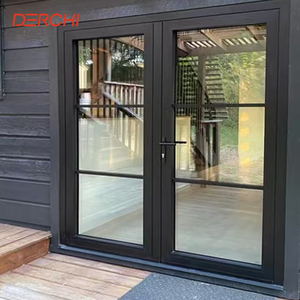
Direct Factory Portfolio
High-Performance Architectural Fenestration Systems
Engineered to international certifications (NFRC, CE, AS2047, CSA) with precision CNC machining, triple-sealed EPDM barriers, and structural load ratings.
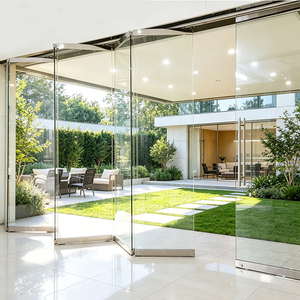
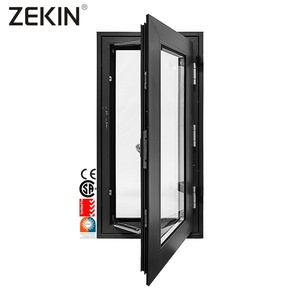
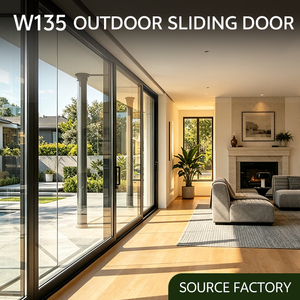
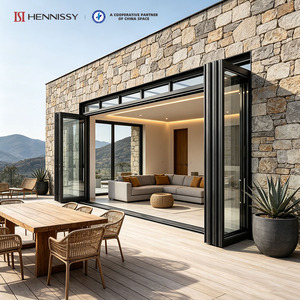
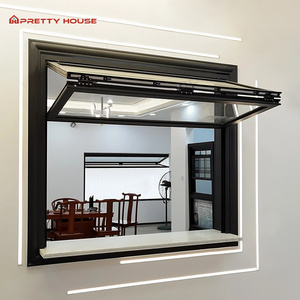
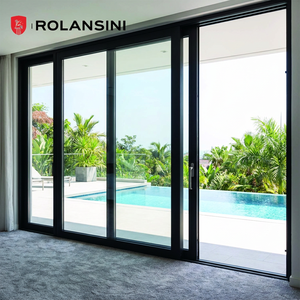
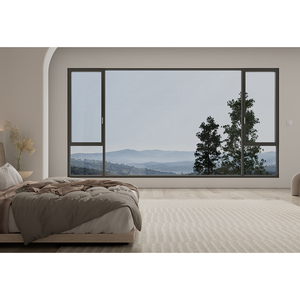
Architectural Whitepaper
Precision Structural Mechanics in Multi-Slide Telescopic Portals
A technical assessment of profile extrusion metallurgy, dynamic wheel carrier friction dynamics, capillary drainage, and thermal barrier continuity in high-span stacking door assemblies.
In modern architectural fenestration, commercial and luxury residential envelopes are shifting aggressively toward uninterrupted panoramic expanses. The aluminum stacking door system—characterized by multi-track configurations where two, three, four, or more panels slide sequentially behind a stationary jamb or pocket—represents the ultimate synthesis of structural rigidity, volumetric flow, and climate resistance. Unlike conventional bi-fold assemblies that suffer from heavy hinge eccentric loads and wind deflection when stacked in windy corridors, telescopic aluminum stacking doors evenly distribute weight over bottom-rolling high-precision carriage trucks, allowing individual leaf weights exceeding 450 kilograms (992 lbs) and portal widths stretching beyond 18 meters.
As premier engineering manufacturers, we design our extrusion alloys utilizing 6063-T6 architectural grade or 6061-T6 structural grade aluminum. Standard profiles exhibit nominal wall thicknesses varying between 2.0 mm and 3.5 mm at principal structural load-bearing web flanges, ensuring deflection criteria satisfy strict structural threshold standards ($L/175$ under normal wind loads, and $L/240$ or stricter for coastal hurricane envelopes). Thermal continuity is preserved through the insertion of glass-fiber reinforced polyamide strips (PA66 GF25), preventing thermal bridge conduction while mitigating condensation risks across rigorous temperature differentials.
Multi-Cavity Polyamide Thermal Break
Multi-chambered 24mm to 34mm PA66 GF25 thermal struts mitigate convective loop heat gains, achieving assembly U-factors down to 1.2 W/(m²·K) when integrated with argon-filled low-E insulated glass units (IGUs).
Quad-Roller Stainless Carriage Mechanics
Tandem and quad bogey wheel assemblies utilizing 316-grade marine stainless steel bearings and CNC machined heavy-duty polymer rollers, tested over 100,000 cycles with a silent rolling coefficient below 0.02.
Cascading Differential Capillary Drainage
Integrated multi-level sill weep channels utilizing pressure-equalized baffled drainage flappers prevent water back-siphonage under severe driving rain, delivering water penetration resistance up to 700 Pa.
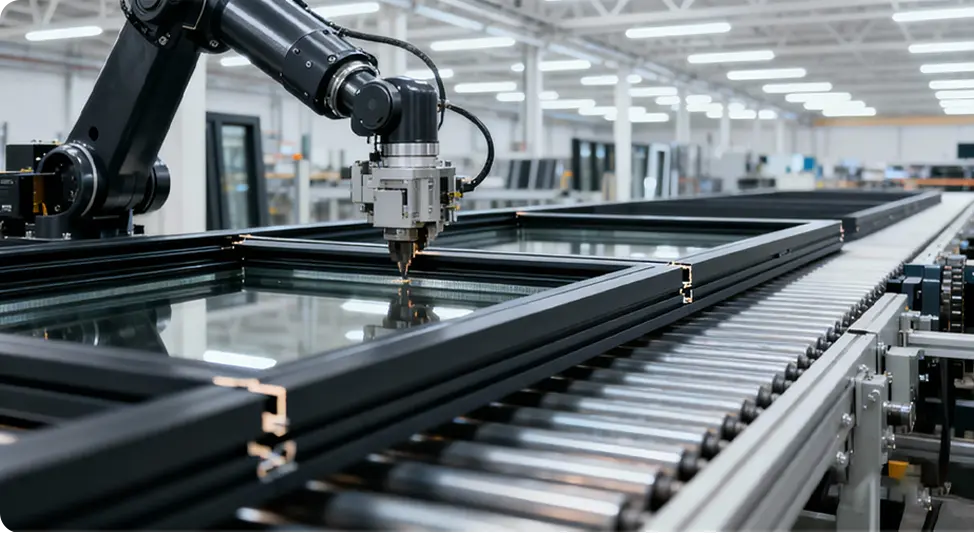
Zero-Error Corner Joining & Extruded Gusset Engineering
Structural failure in multi-slide stacking systems most frequently originates at the mitered frame and sash junctions under continuous torsional dynamic loading. Guangdong Dejiyoupin (DERCHI) solves this vulnerability by deploying high-tonnage automated hydraulic corner-crimping machinery linked with German two-component structural polyurethane adhesive injection.
Cast heavy-wall corner cleats together with spring-steel alignment clips lock outer and inner extrusion chambers in three dimensions. This prevents shear deformation during dynamic panel braking, maintaining continuous acoustic and hermetic sealing across decades of daily high-frequency commercial cycling.
6063-T6 Extrusion
Dual-Component Corner Seal
Four-Side Six-Point Lock
Continuous EPDM Gasket
Specification Standard
Comparative Performance Matrix: Stacking vs. Alternative Large-Span Systems
Objective baseline comparison of structural performance, air tightness, thermal resistance, and operational space economy across architectural door topologies.
| Performance Indicator | Multi-Slide Aluminum Stacking | Bi-Fold (Accordion) Systems | Lift & Slide (Heavy Duty) | Oversized Pivot Doors |
|---|---|---|---|---|
| Maximum Clear Opening | Up to 80% (or 100% with Pocket Wall) | Up to 90% (Side-stacked leaves) | Up to 66% (2-track or 3-track) | 100% of single portal width |
| Max Leaf Weight Capacity | 400 kg – 600 kg per panel | 100 kg – 150 kg per panel | 400 kg – 500 kg per panel | Up to 500 kg per single leaf |
| Air Infiltration (ASTM E283) | < 0.10 cfm/ft² (Triple EPDM + Fin Seal) | < 0.20 cfm/ft² (Multiple vertical joints) | < 0.05 cfm/ft² (Gasket compression drop) | < 0.30 cfm/ft² (Perimeter clearance) |
| Water Penetration (ASTM E331) | Up to 700 Pa (Sub-sill drainage) | 300 – 450 Pa (Weaker at folding hinges) | Up to 750 Pa (Active dropped seals) | 200 – 300 Pa (Vulnerable perimeter) |
| Wind Load Resistance (AS2047) | Up to 4500 Pa (Serviceability / Ultimate) | 2000 – 3000 Pa (Hinge pin deflection) | Up to 5000 Pa (Reinforced mullions) | 2500 – 3500 Pa (Single large span) |
| Thermal Value ($U_w$ Factor) | 1.2 – 1.6 W/(m²·K) with Triple IGU | 1.4 – 1.8 W/(m²·K) with PA66 Break | 1.1 – 1.5 W/(m²·K) Optimized | 1.6 – 2.2 W/(m²·K) (Thermal bridge at pivot) |
| Interior Usable Footprint | Zero intrusion (Parallel panel glide) | Consumes 600–900mm swing perimeter | Zero intrusion (Parallel glide) | Consumes substantial arc radius |
Strategic Procurement Analysis
Future Procurement Trends in Commercial Stacking Portals (2025–2030)
Empirical market intelligence for property developers, general contractors, commercial distributors, and architectural design institutions navigating supply chain transformations.
1. Low-Carbon Metallurgy & Circular Extrusions
Global carbon border adjustment mechanisms (such as EU CBAM) and North American green building mandates are forcing procurement directors to specify aluminum billets produced via renewable hydropower or containing at least 75% post-consumer scrap. Forward-looking suppliers like DERCHI are transitioning to third-party verified Environmental Product Declarations (EPDs), enabling commercial projects to capture LEED v4.1 and BREEAM decarbonization credits directly at factory invoice.
2. Ultra-Narrow Sightlines with Structural Bonded Glazing
The aesthetic demand for "invisible frames" has driven central interlocking mullion widths down from traditional 75mm profiles to ultra-slim sightlines between 20mm and 26mm. Sourcing agents must verify that suppliers utilize structural silicone bonding where the insulated glass unit acts as a rigid diaphragm element ($I_x$ structural moment contribution), preserving extreme wind load deflection resistance without compromising slender minimalist visual proportions.
3. Digitalized Motorization & Building Automation Integration
Heavy stacking doors weighing 500+ kilograms are transitioning rapidly from manual operation to concealed brushless DC motorized drive units. Procurement contracts for luxury residential and institutional hospitality now mandate embedded automation compatible with KNX, Modbus, and smart building interfaces, incorporating magnetic optical encoders, anti-pinch infrared safety sensors, and concealed manual-release emergency clutches in power failure events.
4. Supply Chain De-risking via Modular Knocked-Down Pre-Assemblies
Rising maritime container logistics costs and on-site labor shortages in North America, Europe, and Australia have created a structural shift toward standardized "Knocked-Down" (KD) packaging with pre-machined, plug-and-play assembly jigs. Factories offering zero-clearance tolerance tolerances, pre-drilled anchors, and pre-wired harness channels save developers up to 40% in destination installation labor costs while preventing container volume loss during transit.
R&D Innovation Horizon
Engineering Frontiers: Technological Evolution of Stacking Systems
How advanced material science, surface nanocoatings, and vacuum glass architectures are reshaping the thermal envelope of modern fenestration.
Concealed Recessed Thresholds & Hydrodynamic Vortex Sills
Traditional sliding and stacking portals required prominent 50mm–70mm raised interior sills to prevent stormwater ingress during tropical typhoons and monsoons. The cutting edge of engineering design now achieves true ADA-compliant flush transitions through concealed recessed sill channels.
By engineering subterranean multi-chamber drainage troughs protected by stainless steel capillary grates, incoming water velocity is broken through hydrodynamic vortex deceleration. Sub-floor drainage pipelines discharge bulk water volumes under gravity, allowing unbroken luxury interior-to-exterior continuity without compromising structural weathertightness standards.
Flush Barrier-Free Threshold
Capillary Disruption Rails
Sub-Floor Sump Drainage
AAMA 501.1 Dynamic Test Verified
AAMA 2605 Fluorocarbon (PVDF) Nanocoatings
To resist coastal salt fog, ultraviolet degradation, and high-humidity chemical chalking in C5-M marine environments, profile finishing has evolved from standard powder coatings to 70% Kynar 500 PVDF resin coatings, carrying 20- to 30-year non-fading performance warranties.
Vacuum Insulated Glass (VIG) Integration
By pairing thin-profile Vacuum Insulated Glass with warm-edge composite spacers inside heavy-duty stacking frames, architects can realize centre-of-glass thermal ratings as low as $U_g = 0.45\text{ W/(m}^2\cdot\text{K)}$ without the excessive frame depth and weight of bulky triple-pane units.
Four-Side Six-Point Dynamic Locking Mechanisms
DERCHI's patented multi-point perimeter active engagement gear locks both upper track, lower track, and vertical interlocking mullions simultaneously via hardened stainless steel mushroom cams, delivering RC3/PAS 24 level forced-entry resistance.
Factory Scale & Verification
Guangdong Dejiyoupin: Global Manufacturing Supremacy
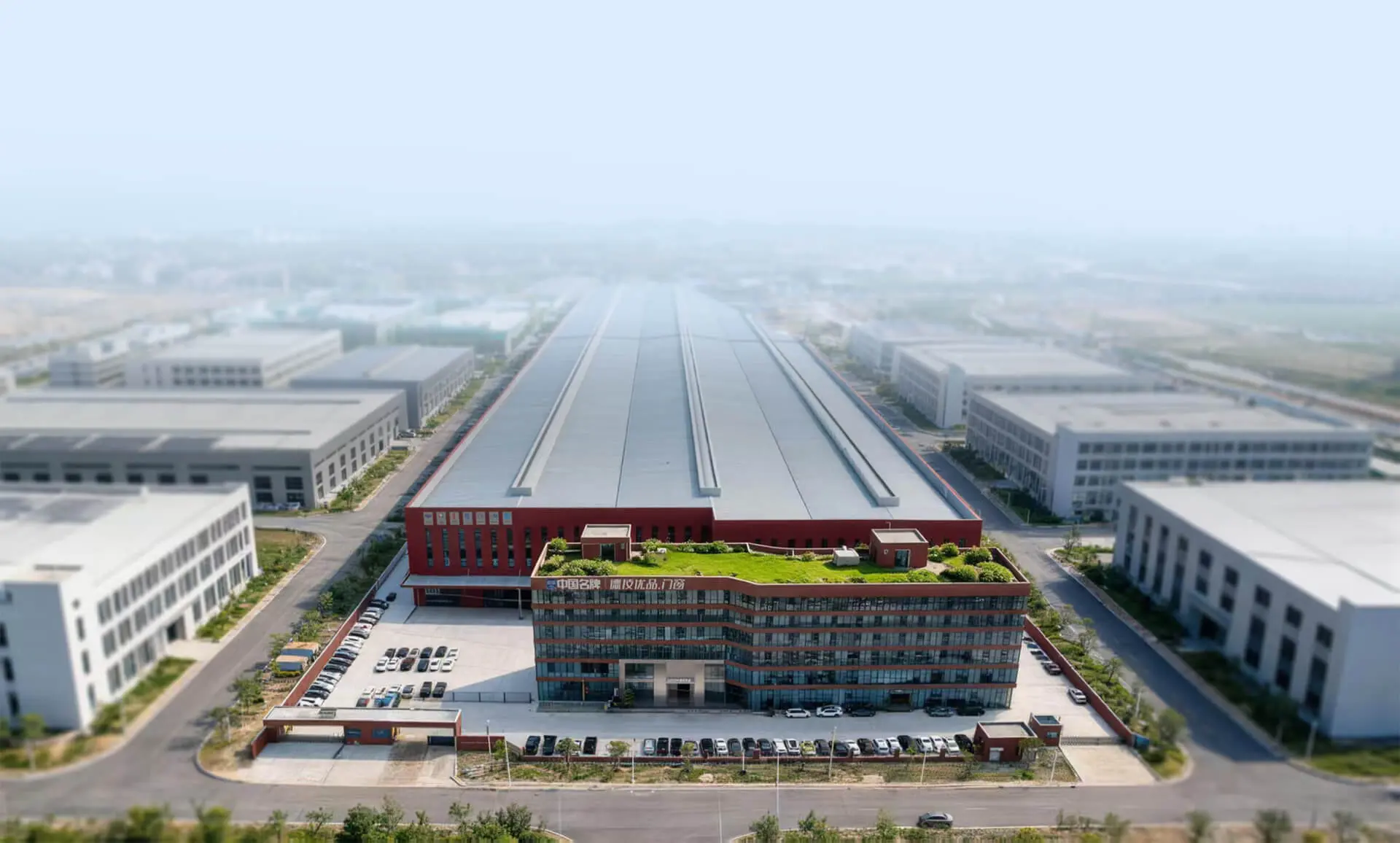
A continuous 25-year institutional track record delivering certified architectural fenestration to leading developers across 18,000+ completed international projects.
180,000
Production Campus (m²)
1,000,000+
Annual Capacity (m²)
100+
National Invention Patents
18,000+
Global Landmark Projects
The "Zero-Error" Intelligent Quality Control Architecture
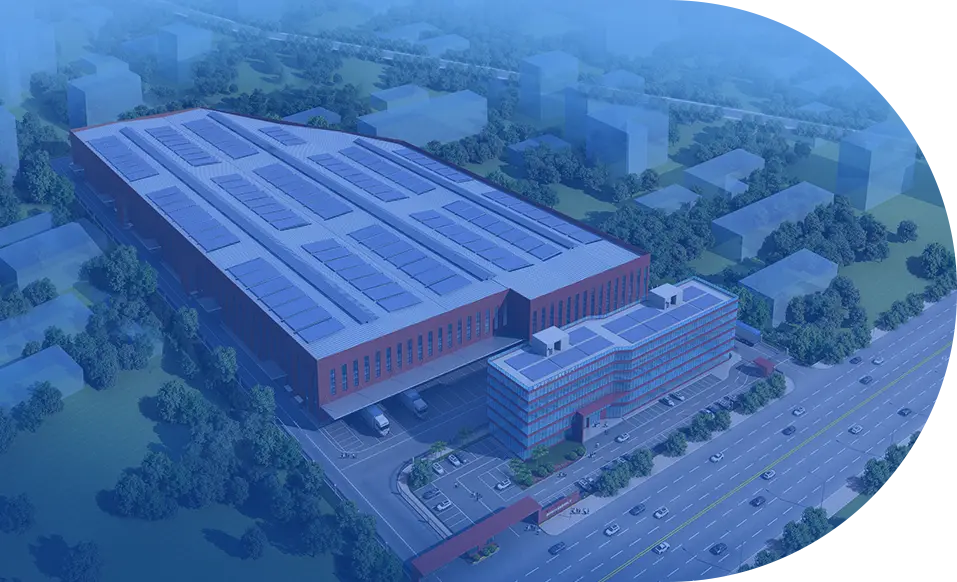
Operating out of Foshan—China's undisputed epicenter for premium aluminum alloy innovation—Guangdong Dejiyoupin Doors and Windows Co., Ltd. (the manufacturer of DERCHI) maintains an expansive 180,000 square meter intelligent industrial campus staffed by over 600 specialized technicians and 30+ dedicated structural fenestration R&D engineers.
Our zero-error operational protocol governs every phase: from digital spectrometer alloy purity testing, five-axis CNC profile machining, robotic corner assembly, automated butyl extrusion, to structural silicone curing within humidity-controlled cleanrooms. Supported by an international certification grand slam—encompassing European CE, American NFRC, Australian AS2047, Canadian CSA, Energy Star, and ISO 9001—our products have served global hospitality brands including Hilton, Atour, and ultra-luxury estates globally.
1. Architectural Drawing & Wind Calculation Review
Our structural engineering department performs finite element structural calculations against your project's architectural opening schedules, elevations, and local regional wind exposure parameters ($V_{ult}$ and $V_{service}$).
2. Precision CNC Milling & 360° Quality Inspection
Extrusions are processed on automated multi-axis CNC routing machinery with robotic dimensional verification, eliminating manual measuring variances down to within ±0.3 mm across ten-meter runs.
3. Specialized Maritime Export Crating & Jobsite Support
Heavy stacking door glass and frames are packed in reinforced, moisture-barrier fumigated steel-corner wooden crates with pre-indexed installation guides, supported by on-site video guidance or flying engineering teams.
Procurement Inquiries
Frequently Asked Commercial & Engineering Questions (FAQ)
In-depth responses resolving common technical queries regarding wind-load deflection, water management, container packing, and customized manufacturing.
How do DERCHI stacking doors meet extreme typhoon and hurricane standards?
Our heavy-duty aluminum stacking door systems are engineered with reinforced internal steel or heavy-wall aluminum stiffening box mullions positioned inside the vertical interlocks. Systems certified to ASTM E1886/E1996 or AS2047 undergo cyclic wind pressure testing up to 4,500 Pa and missile impact testing utilizing multi-layer SentryGlas (SGP) laminated safety glass. All anchor points and perimeter fastener spacing schedules are calculated against specific floor elevations and facade exposures.
What is the difference between a multi-slide stacking door and a lift-and-slide door?
Standard inline stacking doors utilize continuous bottom rollers where panels slide along parallel tracks, relying on multi-layer brush fin seals and EPDM wipe gaskets for weatherproofing. A lift-and-slide system incorporates a specialized internal lever gear: turning the handle rotates the internal mechanism, lifting the 400kg+ door panel off the bottom gasket onto roller wheels for friction-free movement. Lowering the handle drops the door back down, compressing heavy continuous rubber bulb gaskets directly against the frame for maximum air and water tightness.
Can stacking doors be configured to slide into concealed drywall pocket walls?
Yes. We routinely fabricate pocket door configurations where all sliding leaves stack entirely inside an adjacent wall cavity, leaving a 100% unobstructed clear opening between indoor and outdoor living areas. We provide custom extended jamb tracks, specialized drywall receiver trim profiles, and removable pocket access panels that allow long-term servicing of bottom rollers without damaging interior finished wallboards.
What glass configurations are recommended for acoustic dampening (STC/OITC)?
For high-noise urban or airport-adjacent developments, we engineer asymmetrical acoustic laminated double- or triple-glazed units. A typical configuration utilizes 6mm Low-E tempered glass + 16mm argon cavity + (4mm + 0.76mm acoustic PVB + 4mm) laminated glass. The differing glass pane thicknesses disrupt harmonic resonance frequencies, achieving Sound Transmission Class (STC) ratings above 42 dB and Outdoor-Indoor Transmission Class (OITC) ratings exceeding 35 dB.
How are large-span stacking doors packed to prevent transit damage in sea containers?
We deploy two export packing methodologies based on customer jobsite handling capabilities: 1) Fully Pre-Assembled (Unitized) in heavy-duty custom steel-framed A-racks with protective foam interleaving and heat-shrink moisture barrier wrapping; or 2) Knocked-Down (KD) where long tracks and frame profiles are bundled in heavy-gauge cardboard tubing and wooden crates, while glass units are individually cushioned in ISPM-15 compliant plywood crates with desiccant packs to prevent glass clouding during long ocean voyages.
What warranties and after-sales spare parts support does Guangdong Dejiyoupin offer?
All our aluminum structural profiles come with a standard 10-year structural warranty, while AAMA 2605 PVDF surface finishes carry up to a 20-year color-retention warranty against chalking and peeling. German-engineered hardware, multi-point locks, and roller assemblies carry a 5-year replacement guarantee. Furthermore, every project is archived with its precise shop drawing bill-of-materials in our cloud ERP, ensuring exact duplicate replacement glass or hardware can be dispatched within 48 to 72 hours.
Initiate Your Fenestration Project With Factory Direct Engineering Support
Send your architectural CAD elevations, structural wind specifications, or bill-of-quantities to our Foshan R&D engineering headquarters for itemized pricing and comprehensive shop drawings.