Strategic Procurement White Paper
Engineering Resilient Facades for Tropical & Severe Storm Regions
Modern fenestration in extreme coastal environments requires structural compliance beyond decorative appeal. Facing wind pressures above 80 PSF design load and aggressive saline atmospheric moisture, commercial builders, architects, and estate developers depend on rigorous extrusion metallurgical chemistry, multi-chambered thermal breaks, and continuous structural bonding. DERCHI (Guangdong Dejiyoupin Doors and Windows Co., Ltd.) establishes industrial benchmarks with a 180,000 m² smart fabrication base, supplying project-ready hurricane mitigation assemblies across North America, Australia, and Southeast Asia.
Enterprise Core Competence
DERCHI Zero-Defect Manufacturing & Global Compliance
Based in Foshan, China's aluminum industrial cluster, Guangdong Dejiyoupin Doors and Windows Co., Ltd. (DERCHI) combines over 25 years of engineering experience with an integrated industrial ecosystem. Our production safeguards every phase from billet extrusion to structural assembly.
Patented Multi-Point Locking
Featuring our proprietary Four-Side Six-Point Lock mechanism. This system distributes negative wind pressure evenly across structural jambs, preventing perimeter air leakage and forced deflection during severe typhoons.
CNC Precision Mitering
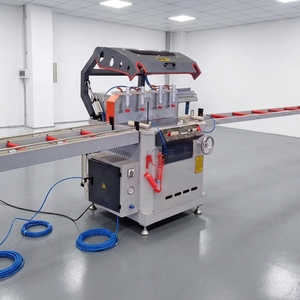
Using industrial high-efficiency profile miter saws and specialized corner crimping, our zero-error manufacturing eliminates micro-gaps. Profiles are injected with structural dual-component corner glues to guarantee watertight joints.
Full International Certification
Our fenestration configurations hold testing compliance with Miami-Dade NOA standards, US NFRC, European CE, and Australian AS2047, offering commercial developers seamless local building permit approvals.
Strategic Horizon
Procurement & Technological Trends in Aluminum Storm Fenestration
Procurement teams are shifting from standard stock sizes to system-integrated, code-compliant engineered solutions. Navigating current global building mandates requires an understanding of these key operational shifts:
Thermal Decoupling in Storm Profiles
Historically, storm windows relied on heavy, thermally inefficient solid extrusions. Modern procurement prioritizes high-load Polyamide PA66 nylon thermal breaks that deliver hurricane-grade structural resistance while meeting strict building energy codes (U-factors < 0.28).
SGP Structural Interlayer Glazing
While PVB interlayers remain standard, commercial specifications increasingly mandate SentryGlas (SGP) ionoplast interlayers. SGP provides five times the tear strength and one hundred times the rigidity of conventional interlayers, preventing post-breakdown storm collapse.
Smart Automation & Sensor Feedback
Modern luxury villas and commercial structures demand motorized vertical-lifting and multi-track sliding systems with hidden actuators. These units connect directly to smart building systems to seal automatically when wind-speed sensors detect storm thresholds.
| Storm Exposure Class | Structural Wind Pressure | Recommended Glazing Specification | Hardware & Sealing Profile |
|---|---|---|---|
| Coastal High-Velocity Hurricane Zone (HVHZ) | ≥ 80 PSF to 120 PSF | 10mm Tempered + 1.52 SGP + 10mm Tempered / Double Low-E | Multi-point stainless 316 drive gear, vulcanized EPDM gaskets, reinforced sills |
| Monsoon Tropical Belt (SEA / Island Regions) | ≥ 50 PSF to 75 PSF | 6mm + 1.14 PVB + 6mm + 12Ar + 6mm Low-E Insulated Glass | Concealed step drainage, high-dam water barrier tracks, anti-corrosion fluorocarbon coating |
| Inland High-Altitude Storm Zones | ≥ 40 PSF to 60 PSF | 5mm + 9Ar + 5mm + 0.76 PVB + 5mm Dual Low-E Units | PA66 multi-cavity thermal break, perimeter compression latches, acoustic isolation pads |
Engineering Protocols
8-Step Comprehensive Project Verification Workflow
Direct factory supply from DERCHI eliminates intermediary communication gaps through our systematic engineering delivery protocol.
01. Architectural Drawing Audit
Our engineering team verifies rough openings, structural spans, and local wind-load requirements against architectural elevations before generating shop drawings.
02. R&D Profile Optimization
Profile wall thicknesses are calibrated (1.8mm to 3.0mm primary structural walls) according to finite element deflection analyses.
03. On-Site Dimension Verification
Laser measurement verification or precise field-tolerance signoffs prevent fitting conflicts on curtain walls, balconies, and structural apertures.
Procurement Knowledge Base
Frequently Asked Questions: Aluminum Storm Windows
Clear, technical guidance on certifications, shipping logistics, structural specs, and custom configurations.
What certifications are required to clear storm windows through customs in the US and Australia?
For the US market, fenestration products in hurricane zones require NFRC thermal performance ratings and impact compliance tested to ASTM E1886/E1996 or Miami-Dade TAS 201/202/203 (NOA standard). For Australia, full compliance with AS2047 and AS1288 is mandatory. DERCHI systems hold testing documentation for smooth port clearance and code inspections.
How do multi-chambered aluminum extrusions prevent water ingress during typhoons?
Monsoon rain drives moisture under dynamic pressure. Multi-chamber designs include isolated decompression chambers, concealed cascade weep holes, and continuous EPDM automotive-grade compression gaskets. This equalizes internal pressure and channels driven water outward through gravity-assisted drainage tracks.
What is the lead time for customized architectural storm window orders?
Standard fabrication runs between 25 and 35 working days following shop drawing confirmation and hardware selection. Our Foshan industrial base produces over 1,000,000 m² annually, allowing reliable containerized ocean shipments via Guangzhou, Shenzhen, or Hong Kong ports.
Can DERCHI storm assemblies integrate both insect screening and thermal breaks?
Yes. We engineer integrated systems combining 304/316 marine-grade stainless steel diamond security meshes with thermal-break extrusions. This guarantees permanent hurricane protection, ventilation, intrusion deterrence, and thermal efficiency within a unified frame.
How are heavy oversized impact glass units protected during ocean shipping?
Export packaging uses fully enclosed, treated solid-wood crates with internal shock-absorbing EVA foam blocks. Corner protectors and moisture-proof plastic sealing shield every frame, preventing glass abrasion, maritime moisture exposure, and mechanical handling shifts.
Connect with DERCHI’s Senior Fenestration Engineering Desk
Submit your CAD blueprints, window schedules, or structural wind load criteria. Our engineering team provides detailed take-offs, code audits, and factory-direct estimates within 24 hours.
Get a Quote