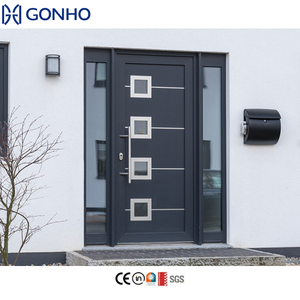
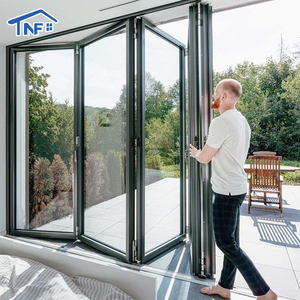
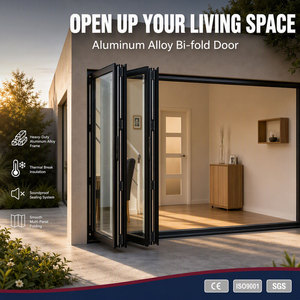
Modern Hurricane Proof Exterior Swing Aluminum Patio Bifold Doors with Glass
Impact Glass
Multi-Track Bifold
Wind-Load ±4500Pa
Engineered to international building standards (AS2047, NFRC, CE, CSA), featuring polyamide thermal breaks, multi-point kinetic locking hardware, and tempered low-emissivity glass assemblies.
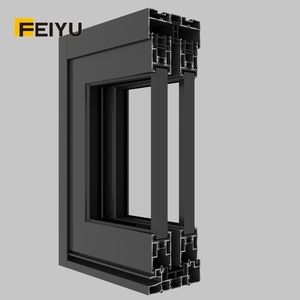
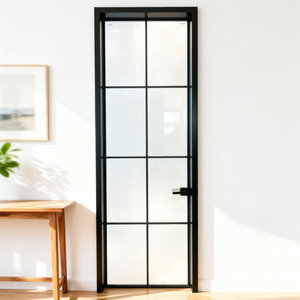
A technical guide for project architects, civil contractors, structural facade engineers, and commercial fenestration distributors sourcing from China.
Aluminum framed glass doors demand rigorous metallurgical verification to prevent deflection under severe positive and negative wind pressures. Premium tier manufacturers in Foshan utilize virgin 6063-T5 or 6063-T6 architectural-grade aluminum billets, strictly controlling impurities such as iron and zinc to under 0.35% and 0.10% respectively. This precise chemistry ensures high tensile yield strength (≥160 MPa) and superior surface uniformity required for architectural fluorocarbon (PVDF) and anodized finishes.
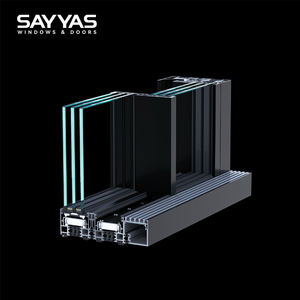
In modern high-performance building envelopes, uninsulated aluminum framing functions as an unwanted thermal bridge. To achieve passive-level thermal insulation values (U-values ≤ 1.6 W/m²·K), our systems integrate precision-extruded polyamide PA66GF25 barrier strips reinforced with 25% longitudinal glass fiber. These structural thermal breaks match the thermal expansion coefficient of aluminum, preventing delamination, shear failure, and structural deflection across extreme ambient temperature swings ranging from -35°C to +80°C.
Our intelligent CNC machining centers operate with precision tolerances within ±0.2mm across profile cutting, drilling, and milling operations. This eliminates on-site alignment modifications during field installation, drastically lowering overall project labor costs and risk profiles for multi-story residential developments and coastal luxury resorts.
| Performance Dimension | Standard Commercial Grade | Export Architectural Specification | Guangdong Dejiyoupin / DERCHI Standard |
|---|---|---|---|
| Aluminum Alloy & Wall Thickness | Recycled billet / 1.2mm - 1.4mm | Virgin 6063-T5 / 1.6mm - 2.0mm | Primary 6063-T6 / 2.0mm - 3.2mm Heavy Duty |
| Thermal Break Configuration | PVC / Low-grade composite <14.8mm | PA66GF25 Polyamide strip 20mm - 24mm | Technoform Multichamber PA66GF25 (Up to 34mm) |
| Glazing Specification | Single or generic 5+9A+5 Dual Pane | 6+12Ar+6 Low-E Tempered Argon-filled | 8+1.52SGP+8 Laminated or Triple Glazed Low-E |
| Wind Load Resistance (P3) | ±1500 Pa to 2000 Pa | ±3000 Pa (Standard AS2047) | ≥±4500 Pa (Severe Typhoon / Hurricane Rated) |
| Air & Water Infiltration | Class 2 (EN 12207) / 250 Pa | Class 3 / 450 Pa (ASTM E331) | Class 4 / ≥700 Pa / Hurricane-grade weepage channels |
| Kinetic Locking Mechanism | Single-point crescent lock | Standard multi-point perimeter gear | Patented 4-Side 6-Point Anti-Theft Locking System |
The glazing assembly constitutes over 75% of an aluminum framed door's surface area, serving as the primary barrier against solar radiation, windward gale pressures, and exterior environmental noise. Our fenestration systems feature insulated glass units (IGU) certified under IGCC, SGCC, and EN 12150 standards. By combining double or triple Low-E (low-emissivity) magnetron sputtering coatings with 95% high-purity argon gas fills and warm-edge silicone structural spacers, our glazed doors reduce the Solar Heat Gain Coefficient (SHGC) down to 0.23, cutting air conditioning energy loads by up to 34%.
For coastal cyclone regions in Southeast Asia, Florida, the Caribbean, and Australia, we engineer high-tenacity laminated safety glass utilizing DuPont SentryGlas (SGP) ionoplast interlayers. Unlike conventional PVB interlayers, SGP structural sheets offer five times the tear strength and one hundred times the rigidity. When subjected to missile impacts during violent storms (ASTM E1886/1996 Large Missile Test Level D), the glass facade maintains barrier integrity even if both outer tempered panes shatter, shielding the structure's interior against catastrophic atmospheric depressurization.
Combining 25+ years of fenestration craftsmanship with industry 4.0 automation across our 180,000 square meter integrated facility in Foshan, Guangdong.
Every extrusion is machined via German-engineered 5-axis CNC profile processing centers. From computerized double-mitre saw cuts to laser-measured hardware slot routing, our quality control maintains micro-tolerances within ±0.2mm to eliminate on-site fitting discrepancies.
DERCHI holds over 100 invention and utility model patents, including our signature Four-Side Six-Point Anti-Theft Multipoint Lock. This mechanism drives stainless steel mushroom cams simultaneously into reinforced frame keeps, providing unmatched anti-pry intrusion defense.
Our products undergo comprehensive type testing in accredited global laboratories, securing full certifications including CE (EU), NFRC (North America), AS2047 (Australia), CSA (Canada), Energy Star, and ISO 9001 compliance for frictionless customs clearing and code approvals.
From prestigious international hotel groups (Hilton, Atour) to luxury private residential compounds in North America, Southeast Asia, Oceania, and Europe, our project portfolio verifies large-scale delivery reliability and lifetime product durability under extreme exposures.
We provide full structural shop drawing reviews, BIM file generation, structural wind load calculation, pre-assembly mock-up inspection, sea freight container load optimization, and comprehensive digital or on-site installation guidance.
Located in Foshan within the Greater Bay Area, our factory is minutes from Guangzhou and Shenzhen maritime hubs. We ensure accelerated transit times across major Pacific, Indian Ocean, and Trans-Atlantic freight corridors with custom protective steel crate crating.
Anticipate regulatory shifts, technological integrations, and design movements transforming commercial and residential fenestration markets.
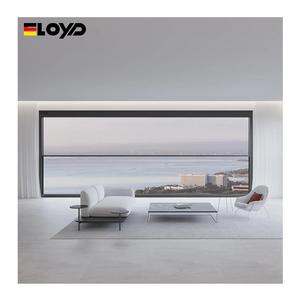
Architects worldwide increasingly mandate uninterrupted views. The procurement trend is shifting toward "invisible" perimeter frames where the outer aluminum profile is completely embedded within the structural plaster and subfloor. With visible mullion sightlines engineered down to 16mm–21mm, high-load stainless steel rollers carry sash weights up to 600kg while offering effortless finger-touch gliding kinematics.
Manual sliding systems are transitioning rapidly into motorized, IoT-enabled platforms. Future-proof specifications incorporate concealed brushless magnetic levitation motors built into the top head track, operating below 35dB. These systems integrate smoothly with automated building management systems (BMS), reacting autonomously to environmental wind-rain sensors, facial recognition access, and smart HVAC zoning control.
International environmental regulations (EU Carbon Border Adjustment Mechanism and LEED v4.1 credits) are pushing procurement directors toward green low-carbon aluminum billets smelted using hydroelectric or solar energy. Door systems certified with verified Environmental Product Declarations (EPD) that utilize post-consumer recycled aluminum will dominate commercial specifications through 2030.
Due to the increased frequency of severe weather events, global building codes are elevating mandatory water penetration thresholds from 300Pa to 700Pa+ across non-traditional hurricane regions. Sourcing specifications now emphasize multi-stage baffled sub-sill drainage gutters that channel cascading rainwater out through kinetic check valves even under sustained gale gusts.
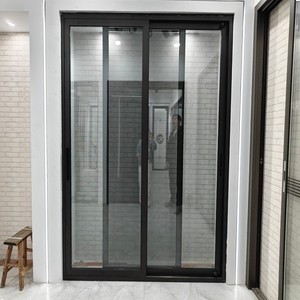
Real estate developers increasingly avoid fragmented supplier models. The procurement mandate favors single-source manufacturers capable of executing the complete building envelope: matching the thermal and powder-coat finish of exterior large-span patio sliders, bi-fold doors, slim interior glass partitions, sunrooms, and bespoke aluminum entry doors.
In-depth technical answers addressing risk reduction, customs compliance, freight logistics, and engineering specifications for overseas door buyers.