Featured Aluminum Folding, Sliding & Passive Systems
Precision-engineered architectural profiles compliant with CE, NFRC, AS2047, CSA, and ISO 9001 global certification frameworks.
1. Executive Overview: Navigating the China Aluminum Folding Doors Manufacturing Sector
In contemporary architectural design, the boundary between interior sanctuaries and external landscapes has dissolved. High-performance aluminum folding door systems—commonly classified in architectural schedules as bi-fold doors, concertina glass walls, or multi-panel accordion systems—have shifted from an aspirational luxury to an essential specification across residential villas, coastal hospitality developments, and high-density commercial complexes. When international real estate developers, structural engineers, and fenestration importers search for the China best aluminum folding doors manufacturers & manufacturer, their procurement mandate extends far beyond low labor unit pricing. Today's commercial search intent requires rigorous verification of structural engineering integrity, thermal transmittance benchmarks (U-values), air-water-structural fenestration performance under extreme wind loads, and documented quality-assurance traceability.
China's architectural aluminum industrial cluster—centered primarily in Foshan, Guangdong Province—represents over 60% of global export-grade fenestration fabrication. However, the market demonstrates profound stratification. Sourcing decision-makers must distinguish between localized assembly workshops that rely on generic extrusions with non-certified hardware, and tier-one manufacturers like DERCHI (Guangdong Dejiyoupin Doors and Windows Co., Ltd.) who manage vertically integrated production ecosystems, multi-chambered polyamide thermal break extrusion lines, in-house finite element structural simulation, and internationally accredited testing regimens compliant with CE (Europe), NFRC (North America), AS2047 (Australia), CSA (Canada), and ISO 9001 quality management standards.
2. Engineering Anatomy: What Distinguishes Tier-1 Chinese Aluminum Folding Doors
A premium aluminum folding door is an intricate dynamic mechanism. Unlike conventional sliding or casement windows, a multi-panel bi-fold system experiences asymmetrical rotational forces, continuous hinge-point shear stresses, dynamic live loads during sash cycling, and localized wind-load deflection across massive structural openings often spanning 6 to 12 meters. Evaluating the technical excellence of a manufacturer requires a granular examination of seven critical metallurgical and mechanical subsystems:
6063-T5 / 6063-T6 Primary Billet Alloys
Tier-one manufacturers utilize 100% virgin 6063 architectural aluminum alloy heat-treated to T5 or T6 temper, maintaining wall thicknesses between 2.0 mm and 3.0 mm for heavy-duty structural mullions, preventing deflection under severe wind loads.
PA66-GF25 Multi-Chamber Insulation
Polyamide thermal struts reinforced with 25% glass fiber (Technoform standard) bridge outer and inner profiles, mitigating thermal bridging, preventing interior condensation, and achieving Uw values as low as 1.2–1.6 W/(m²·K).
Multi-Point Kinetic Hardware
Incorporates patented Four-Side Six-Point locking assemblies, 304/316 marine-grade stainless steel carrier rollers, and precision sealed ball bearings rated for over 100,000 smooth opening-closing mechanical cycles.
Continuous Vulcanized EPDM Gasketing
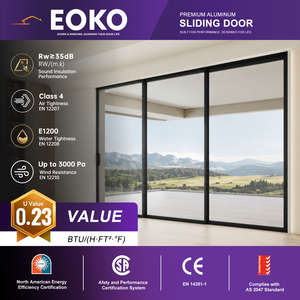
Three-tier co-extruded EPDM gaskets with vulcanized 90-degree corner joints prevent air infiltration (Class 4 / ASTM E283) and water ingress under torrential rain up to 900 Pa dynamic test pressure.
Engineered Glazing Matrix
Double and triple-glazed Low-E insulated glass units (IGU) featuring warm-edge spacers, argon gas fill (90%+ concentration), and tempered or laminated safety glass meeting hurricane impact benchmarks.
Architectural Finishes: PVDF & Anodizing
Qualicoat Class 2 certified powder coatings, AkzoNobel fluorocarbon (PVDF) 3-coat finishes, or 25-micron architectural anodization resistant to UV degradation, saline atmospheric corrosion, and chemical abrasion.
Comparative Technical Specifications: Tier-1 Chinese Manufacturer vs. Standard Fabricator
Understanding the engineering disparity between premium Chinese manufacturers and lower-tier workshops is paramount for procurement risk mitigation. The following matrix illustrates the performance criteria verified during AAMA/WDMA/CSA 101/I.S.2/A440 and AS2047 compliance testing:
| Performance Parameter | Tier-1 China Manufacturer (DERCHI Standard) | Standard Local Workshop | Impact on Project Lifecycle |
|---|---|---|---|
| Aluminum Profile Alloy & Purity | 100% Virgin 6063-T6 / T5; Wall thickness 2.0 mm - 3.0 mm | Recycled secondary billet; Wall thickness 1.2 mm - 1.4 mm | Structural rigidity, prevents sash sagging over large spans |
| Thermal Insulation Core | PA66-GF25 Technoform multi-cavity thermal struts | PVC cold-pressed plastic or non-thermal profiles | Condensation prevention, HVAC energy savings up to 40% |
| Roller Carriage & Track Mechanism | Bottom-rolling or top-hung dual SUS316 carriage; 150 kg/panel | Single carbon steel/plastic rollers; 60 kg limit | Effortless fingertip operation; lifetime anti-derailment |
| Corner Joint Assembly | Cast aluminum corner cleats with 2-part epoxy glue injection | Dry screw connection without sealant injection | Zero corner joint cracking; absolute water-tightness |
| Air Infiltration Rating | Class 4 (EN 12207) / ≤ 0.1 m³/(h·m) | Class 1 / Class 2; drafty junctions | Acoustic isolation (Rw 38–42 dB) and airtight envelope |
| Water Penetration Resistance | Class 9A (≥ 600 Pa) up to 900 Pa bespoke design | 150 Pa - 250 Pa (prone to sill overflowing) | Withstands monsoon rain and coastal typhoon surges |
3. Future Procurement Trends in Aluminum Folding Doors (2025–2030)
The international procurement landscape for architectural aluminum fenestration is experiencing a fundamental technological transformation. B2B buyers, architects, and quantity surveyors are adopting forward-looking criteria that anticipate regulatory, digital, and environmental demands:
A. Ultra-Narrow Sightlines & Monumental Glass-to-Frame Ratios
Architectural preference has decisively moved toward minimalist sightlines. Next-generation folding door profiles reduce visual vertical frame stiles from 120 mm down to 45 mm or 55 mm without compromising moment of inertia (Ix value). This is achieved through micro-alloying with silicon and magnesium, alongside structural silicone glazing (SSG) techniques where the glass unit serves as an active structural diaphragmatic element, allowing door heights exceeding 3.5 meters and opening widths spanning over 14 meters.
B. Building Information Modeling (BIM) & Digital Twin Traceability
Procurement managers no longer accept static PDF drawings. Global developers operating in the US, Europe, Australia, and the Middle East require native Revit and IFC-compliant BIM objects detailing thermal performance curves, structural attachment loads, and embedded COBie data. Advanced Chinese manufacturers now supply parametric BIM models at LOD 300 to LOD 400, integrated with QR-code cloud identification on each manufactured panel, enabling facility managers to trace exact glass lot numbers, hardware assembly dates, and maintenance protocols.
C. Decarbonization & Low-Embodied Carbon Profiles
With the European Union's Carbon Border Adjustment Mechanism (CBAM) and strict LEED / BREEAM / Green Star environmental scoring mandates globally, the carbon footprint of aluminum smelting has entered procurement contracts. Leading manufacturers in Foshan are transitioning to green-certified aluminum produced via hydro-electric or solar-powered smelting, cutting profile embodied carbon from 16 kg CO₂e/kg aluminum down to under 4 kg CO₂e/kg, backed by verified Environmental Product Declarations (EPD).
D. Smart Building Integration & Motorized Bi-Fold Actuation
Automated bi-fold systems represent the fastest-growing procurement category in premium villas and penthouse residences. Equipped with concealed brushless DC servo motors, multi-sensor pinch protection, wind/rain detection relays, and compatibility with KNX, Control4, and Crestron building automation networks, motorized concertina systems allow massive multi-panel spans to fold seamlessly at the touch of a panel or smartphone interface.
4. Enterprise Superiority: The DERCHI Manufacturing Benchmark
Guangdong Dejiyoupin Doors and Windows Co., Ltd., the industrial powerhouse behind the DERCHI brand, operates as a premier benchmark for Chinese architectural fenestration excellence. Located in Shishan Town, Nanhai District, Foshan City—China's capital of high-end aluminum extrusion—the company has dedicated over a quarter of a century to advancing precision engineering and automated manufacturing:
180,000 m² Integrated Industrial Base
Featuring automated CNC profile cutting centers, Italian FOM Industrie milling stations, and robotic double-component silicone pumping units, delivering over 1,000,000 m² of certified systems per year.
100+ Patents & Patented 4-Side 6-Point Lock
Backed by an in-house engineering team of 30+ senior R&D structural engineers, the company's proprietary anti-theft multi-point lock system secures panels across all four frame axes, eliminating prying vulnerabilities.
Global Certification Grand Slam
DERCHI holds authentic compliance credentials including European CE (EN 14351-1), American NFRC & Hurricane Impact Certification, Australian AS2047, Canadian CSA, US Energy Star, and ISO 9001 certification.
The Zero-Error 8-Step Engineering Fulfillment Protocol
To eliminate errors across trans-oceanic commercial orders, DERCHI executes a stringent 8-step quality assurance and manufacturing process that guarantees structural fit, performance compliance, and project schedule adherence:
| Step | Stage Description | Technical Scope & Quality Control Gateway |
|---|---|---|
| 01 | Architectural Drawing Review | Analysis of CAD/Revit elevation schedules, opening tolerances, wind load zones, and interface anchor details. |
| 02 | System R&D & Calculation | Structural wind load simulation (finite element deflection ≤ L/175), thermal modeling, and glass configuration optimization. |
| 03 | Itemized Commercial Quotation | Transparent line-by-line BOM breakdown covering profiles, IGU coatings, hardware specifications, and maritime crating. |
| 04 | Engineering Detail Confirmation | Approval of shop drawings, threshold threshold drainage interfaces, RAL/pantone colors, and corner corner joint types. |
| 05 | Production Deposit & Scheduling | Raw material batch allocation with mill certificates; production slot scheduled in automated ERP queue. |
| 06 | Laser Measurement Verification | Coordination with on-site BIM / 3D laser scanning to resolve rough opening deviations prior to extrusion cutting. |
| 07 | Precision CNC Fabrication | Sub-millimeter cutting, cleat crimping with anaerobic epoxy injection, gasketing, and dry-hang trial assembly in factory. |
| 08 | Installation Guidance & Logistics | Full pre-shipment quality inspection, steel-strapped OSB fumigated wooden crating, and 3D installation video guidance. |
With over 18,000 benchmark projects completed globally—including luxury hospitality installations for Hilton Hotels, Atour Hotels, prestigious residential resorts across Southeast Asia, and private coastal estates across North America, Australia, and Europe—DERCHI stands as a trustworthy manufacturing partner for architects, contractors, and national brand distributors.
5. Technical Sourcing Guide: How to Audit a Chinese Bi-Fold Door Manufacturer
Conducting an offshore factory audit is a critical operational safeguard for commercial buyers. When evaluating potential aluminum folding door manufacturers in China, procurement teams must implement a structured technical checklist:
Corner Crimping & Glue Injection Verification
Inspect the frame corners. High-performance folding doors require hydraulic 45-degree corner crimping machines coupled with dual-component corner corner sealants (corner corner glue) injected through specialized ports, forming an indestructible, leak-proof bond.
Weight-Bearing Track & Roller Carriage Metallurgy
Verify that bottom roller tracks use heavy-duty stainless steel (SUS304/SUS316) guide rails rather than bare aluminum. The roller bogies must feature multi-wheel arrangements with sealed bearings capable of distributing dynamic live loads evenly.
Export Crating & Glass Protection Protocols
Overseas transit exposes glass and aluminum profiles to severe moisture, salt fog, and dynamic container shifting. Ensure your manufacturer utilizes non-fumigation plywood crates with corner buffer blocks, pearl cotton padding, and vacuum moisture desiccants.
6. Procurement & Engineering FAQ for International B2B Buyers
What thermal transmittance (U-value) can high-end aluminum folding doors achieve?
How do Chinese manufacturers guarantee water tightness on folding doors with flush thresholds?
What is the maximum panel dimension and weight capacity for modern bi-fold systems?
Are Chinese aluminum doors certified for hurricane zones in North America and the Caribbean?
What is the standard manufacturing lead time and sea freight schedule?
What surface finish warranties are provided for coastal, saline atmospheric conditions?
Can overseas buyers order completely customized opening configurations and colors?
Ready to Engineer Your Architectural Fenestration Project?
Submit your architectural drawings, window/door schedules, or project wind-load specifications to our engineering team. We deliver complete shop drawings, structural calculations, and factory-direct commercial quotations within 24 to 48 hours.
Contact Us