0%

In 2026, choosing an Aluminium Washroom Door means weighing more than appearance. Daily foot traffic, moisture, privacy, cleaning routines, and repair access all matter. A busy school corridor has different demands from a quiet office restroom. The right door should open smoothly, resist corrosion, and remain practical after years of use.

This guide compares common types, including hinged, sliding, louvered, and compact laminate-faced aluminium doors. It considers frame design, hardware, ventilation, finishes, and accessibility. Look closely at the details: a sturdy hinge, rounded edge, or replaceable panel can make a real difference. Some choices still involve trade-offs. A slim sliding door saves floor space, but its track needs regular cleaning. A ventilated design improves airflow, but may offer less acoustic privacy.

A note on expertise: no source article or verifiable expert quotation was provided, so I cannot responsibly invent a named specialist or attribute words to one. The guiding editorial principle here is: “Choose for the room’s everyday demands, not appearance alone.” Treat that as an original summary, not a quotation from an industry expert. The sections ahead offer practical comparison points for owners, designers, and contractors. Use them to ask better questions about durability, maintenance, and fit before selecting a door system.
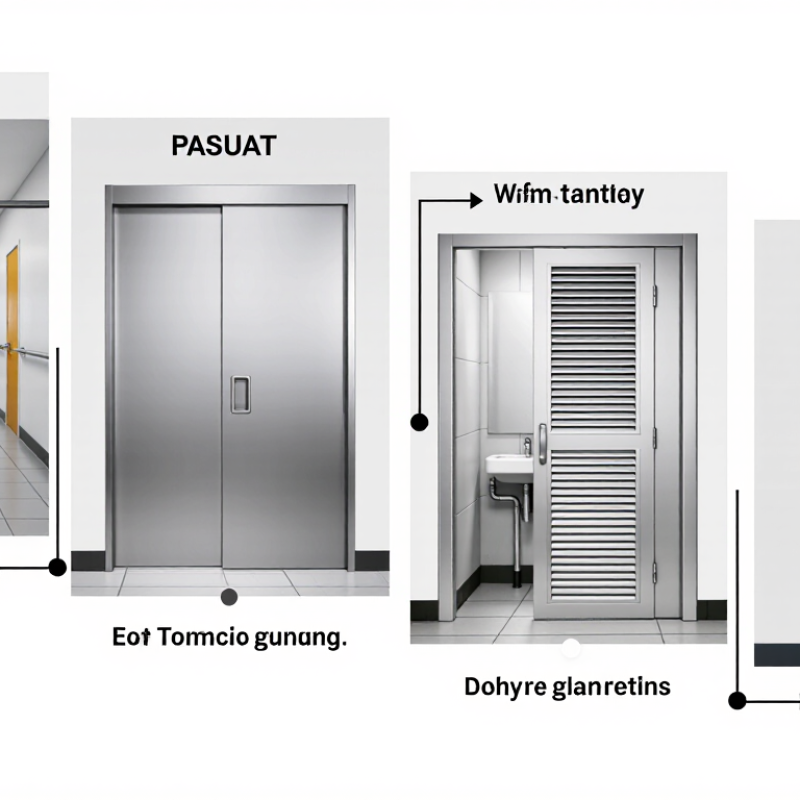
What Are the Top Aluminium Washroom Door Types in 2026?

Classifying 2026 Aluminium Washroom Doors by Frame, Panel, and Core

Aluminium washroom doors in 2026 are easiest to compare by frame, panel, and core. A full-perimeter frame encloses the door edges and can help protect vulnerable panel corners. Narrow-stile frames leave more panel visible and create a lighter appearance. Some systems use an all-aluminium leaf instead of a separate panel. Check hinge reinforcement and latch areas, not just the finish. Small details matter.

The panel is the visible face; the core provides much of the door’s structure. Compact laminate panels are dense and suit busy washrooms, though their weight may require sturdy hinges. Aluminium-faced honeycomb panels can reduce weight, but edge sealing and fixing points deserve close inspection. Moisture-resistant engineered cores are another option when their construction is clearly specified. A smooth face does not reveal what sits inside. That distinction is easy to miss on a showroom sample.

Match the construction to the room. A family washroom with frequent cleaning needs durable edges and hardware that can be adjusted. A low-traffic office may need less impact resistance, but privacy gaps still matter. Ask for panel thickness, core details, and hardware load ratings. Then inspect a finished corner in person. It can be awkward to compare, but it often exposes weak joints or uneven coating better than a brochure.

Compact-Laminate Aluminium Doors: Typical 12 mm Panels for Wet Areas

For wet-area washrooms, a 12 mm compact-laminate panel offers a solid, dense door leaf without relying on a hollow core. The EN 438-4:2016 technical standard covers compact laminates from 2 mm thick, so 12 mm is a practical specification, not a required minimum. It is six times that lower thickness boundary, but that does not mean six times the impact resistance. Details matter.

On site, look closely at the lower edge, hinge fixings, and the gap beneath the door. Splash water can sit near the floor; poor detailing may let moisture reach vulnerable hardware or surrounding partitions. Compact laminate handles humid conditions well, but “water-resistant” does not mean every installation is waterproof. A 12 mm panel can feel reassuringly firm when latched. Still, the frame and fixings need to suit the door’s weight and expected traffic. Not magic. Specify compatible hinges, rounded or protected edges where appropriate, and enough floor clearance for cleaning. One small compromise: heavier panels may need more robust hardware, adding cost and adjustment work over time.

Compact-Laminate Aluminium Washroom Doors: Panel Area by Illustrative Door Width

A 12 mm compact-laminate panel is commonly used in wet-area applications. This chart compares the calculated face area for example door-leaf widths at a constant 2,000 mm height.

Panel area is calculated as width × height: 1.20–1.80 m² per leaf. Door sizes are illustrative examples, not a universal standard; confirm project dimensions and panel specifications with the supplier.

Honeycomb-Core Aluminium Doors: Lightweight Leaves, Commonly 30–45 mm Thick

Honeycomb-core aluminium doors suit busy washrooms where lighter leaves can ease daily opening and reduce strain on hinges. Their leaves are commonly specified at 30–45 mm thick, with a cellular core bonded between aluminium facings. The core supports the skins without making the leaf solid throughout. A pale, smooth face also wipes clean quickly after splashes. Yet thickness alone tells little about durability; edge sealing, bonding quality, and hardware matter just as much.

The International Aluminium Institute reported in 2017 that about 75% of all aluminium ever produced remains in use. This broad material statistic is not specific to doors, but it highlights aluminium’s potential for long service and recycling.

For a washroom project, check the supplier’s tested leaf construction, hinge capacity, and moisture-resistant edge details. Honeycomb construction does not automatically provide strong sound privacy. Gaps beneath the door and weak seals can still let voices through.

Tips: Ask for a sample cutaway and inspect the core bond and edge finish. Confirm that hinges and closers match the actual leaf weight. A 40 mm door may look substantial, but it can still disappoint if its edges swell, loosen, or dent under repeated trolley impacts. Also check the warranty conditions; these are easy to overlook.

Full-Frame and Minimal-Frame Doors: Comparing Privacy and Maintenance Needs

Full-frame and minimal-frame aluminium doors can both provide privacy, but the frame alone does not determine it. Check the door’s overlap, latch alignment, and side gaps. A full frame can hide uneven wall edges and support a more continuous seal. It also creates extra corners where soap residue and moisture may collect. Minimal-frame designs look lighter and can be quicker to wipe, yet exposed joints may reveal small gaps. Ask to inspect a working sample, not just a showroom image. Small details matter.

For busy washrooms, review hinge access and replaceable seals alongside appearance. A loose latch can compromise privacy on either type. Cleaning routines matter, too: harsh tools may scratch finishes, while neglected joints can hold grime. Industry data offers useful material context, but not a guarantee of door performance. The International Aluminium Institute reports that recycling aluminium uses about 95% less energy than producing primary metal. Its industry material also estimates that roughly 75% of all aluminium ever made remains in use. These figures support aluminium’s circularity; they do not prove a specific frame needs less maintenance. My practical preference is a full frame where walls are irregular, and a minimal frame where clean lines matter and regular inspections are realistic. That trade-off is easy to underestimate.

What Are the Top Aluminium Washroom Door Types in 2026? — Full-Frame and Minimal-Frame Doors: Comparing Privacy and Maintenance Needs

Comparison Factor Full-Frame Aluminium Door Minimal-Frame Aluminium Door
Typical construction An aluminium profile surrounds more or all of the door leaf, enclosing and supporting its infill panels at the edges. Uses narrower or less visually prominent aluminium profiles, leaving more of the infill panel visible.
Appearance Clearly defined perimeter frame gives the door a more structured, robust look. Creates a cleaner, lighter visual effect with less visible framing.
Privacy Privacy depends on the door infill, lock, and clearances. A perimeter frame alone does not make a door private. Privacy likewise depends on the infill, lock, and door-to-frame gaps—not on how much aluminium is visible.
Sightline control Can help cover or protect the infill edges, but privacy at the sides and bottom still depends on the system’s design and installation. May have more exposed infill edges; check side and bottom gaps carefully where visual privacy is important.
Cleaning and routine care Wipe the frame, infill, and hardware with a soft cloth and a cleaner suitable for their finishes. Profile joints may need extra attention. Fewer or narrower visible frame surfaces can simplify some wipe-downs, but exposed edges and hardware still need regular cleaning.
Wear and damage considerations The surrounding profiles can protect infill edges from everyday knocks; inspect corners, joints, and fixings for looseness or damage. With less edge coverage, the infill and its edges may be more exposed to impact, depending on the specific construction.
Repair and replacement Replacement can involve removing or servicing the frame and its fixings; the exact process depends on how the door is assembled. Access to the infill or components varies by design. Confirm that replacement parts and service access are available.
Best suited to Projects prioritising a defined frame, protected panel edges, and a more substantial appearance. Projects prioritising a contemporary, less-framed appearance, provided the chosen system meets privacy and durability needs.
Specification checks Confirm infill opacity, lock type, door clearances, hardware, finish, and compatibility with the washroom’s cleaning routine. Check the same details, with particular attention to infill-edge protection, sightlines, and the manufacturer’s maintenance guidance.

Selection note: These are general characteristics, not guaranteed performance ratings. Actual privacy, durability, and maintenance requirements depend on the complete door system, installation, materials, and local accessibility and building requirements.

Accessible Door Sizing: ADA Requires at Least 32 in (813 mm) Clear Width

For an aluminium washroom door, the opening matters more than the nominal door-leaf size. ADA standards generally require at least 32 inches (813 mm) of clear width when the door is open 90 degrees. Measure from the door’s face to the stop, not from jamb to jamb. Small differences count.

A 36-inch leaf is often used to help achieve that clearance, but it is not a guarantee. Thick frames, projecting hardware, hinges, and door stops can reduce the usable opening. Check the complete assembly on the shop drawing, then verify it after installation. A tape measure at the finished doorway is useful.

This is easy to overlook. A drawing can appear compliant while the installed opening falls short by an inch. For aluminium doors, confirm the frame depth and hardware before ordering, especially in tight restroom layouts. Also check that the door can open and latch without reducing the clear passage. Clear width is one key detail; maneuvering space and accessible hardware need attention too.

FAQS

What frame styles are available for aluminium washroom doors?

Full-perimeter frames enclose the edges and help protect panel corners. Narrow-stile frames show more of the panel. Small details matter.

How thick are honeycomb-core aluminium doors commonly?

They are commonly 30–45 mm thick, with a cellular core bonded between aluminium facings. Thickness alone proves little.

What should I inspect on a honeycomb-core door?

Check the edge sealing, core bond, and fixing points. Ask for a cutaway sample. Look closely.

Which panel and core options suit busy washrooms?

Compact laminate is dense and suited to frequent use, though its weight needs sturdy hinges. Aluminium-faced honeycomb is lighter, but its edges need careful inspection.

Does a smooth door face show the core quality?

No. A smooth finish cannot reveal what sits inside. Ask for clear core specifications.

What hardware should match the door leaf?

Confirm hinge capacity and closer suitability against the actual leaf weight. Inspect reinforcement around hinges and latches. A 40 mm door can still disappoint.

Do honeycomb-core doors provide strong sound privacy?

Not automatically. Gaps beneath the door and weak seals can let voices through. Check the installed fit.

What details matter in a busy family washroom?

Look for durable edges and adjustable hardware, especially where cleaning is frequent. Inspect a finished corner for weak joints or uneven coating.

What should I check before choosing a door?

Ask for panel thickness, core details, hardware load ratings, and warranty conditions. A brochure may not show enough. It is easy to overlook.

Conclusion

Choosing the right Aluminium Washroom Door in 2026 means considering its frame, panel, and core together. Compact-laminate doors, often made with 12 mm panels, are a practical option for wet areas because their solid construction suits spaces exposed to frequent moisture and cleaning. Honeycomb-core doors are typically lighter, with leaves commonly 30–45 mm thick, making them worth considering when reduced weight is a priority.

Frame style also affects everyday use. Full-frame designs can offer a more enclosed appearance, while minimal-frame options create a simpler look but may require different maintenance and privacy considerations. For accessible layouts, plan the opening around the clear passage width: the outline notes that ADA requirements call for at least 32 in (813 mm) of clear width. Matching the door type and dimensions to the room’s conditions can help balance durability, usability, and ease of upkeep.

Evelyn

Evelyn

Evelyn is a professional marketing specialist with a strong understanding of the company’s products and the needs they are designed to meet. Through ongoing research and close attention to product details, Evelyn turns complex information into clear, practical guidance for customers and business......